Jakob Vinther Paleontologist
If you are interested in paleontology, you might’ve heard about one notable figure in this field of science – Jakob Vinther. Jakob Vinther is a specialist in the field of paleontology who has made a long way and already left a huge footprint in science. But, how did all it start?
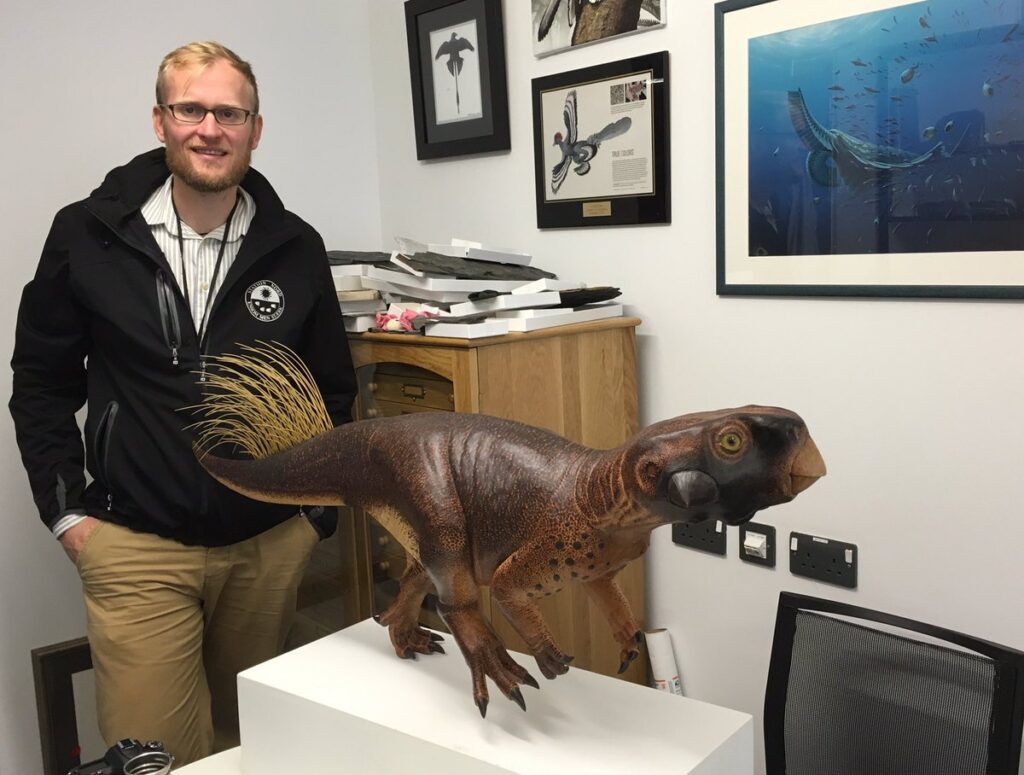
Jakob Vinther is a young and enthusiastic specialist who origins from Denmark. The paleontologist is half Danish and half Icelandic. Jakob discovered his passion for paleontology at a rather young age and worked hard to pursue his goal to become a professional paleontologist.
After graduating high school, Jakob acquired a Bachelor’s and Master’s degrees in the field of paleontology. Both degrees Vinther acquired at the University of Copenhagen in his native country. Also, at the same university, Jakob studied geology.
After graduating from his Master’s course in Denmark, Jakob Vinther made a huge change in his life and moved to the USA.
After moving from his native country, Jakob continued studying paleontology. He enrolled at Yale University in the US to acquire his Ph.D. degree. In 2011, Jakob Vinther graduated from Yale University. During his Ph.D. program, he was working on a project that studied the possibilities for integration of the fossil record of invertebrates with molecular phylogenetics and molecular clocks.
After graduating with a Ph.D. degree, Jakob continues devoting himself to research and his scientific career. The core goal Jakob Vinther pursues in his academic career is to understand the flow of the animals’ evolution and the way it impacted the geosphere and biosphere on our planet.
As the paleontologist says himself, he has a particular interest in studying fossilization processes. The discipline that studies this is called taphonomy. A huge part of his commitments at the current time is devoted to the question of melanin preservation in fossils and the possible uses of it for the reconstruction of color patterns of feathered dinosaurs.
Apart from this, Jakob’s research also covers a range of other subject matters. He is particularly focused on the evolution of animals throughout the period called Ediacaran-Cambrian radiation (or Cambrian explosion).
In addition to this, Jakob Vinther also devotes his time to educating new generations of scientists and researchers. He is a senior lecturer at the School of Earth Sciences and the School of Biological Sciences. Just like his research projects, Jakob’s lectures are focused on two major disciplines – Evolutionary Biology and Palaeobiology. The exciting story about Jakob’s activities doesn’t end here. So, if you’d like to read it till the end, make sure you have time for it – send a ‘write my essay‘ message to the respective services and make yourself comfortable.
Dr. Jakob Vinther: His World
What does Jakob Vinther do in his research? What contribution does he make?
Together with his research group, Jakob studies anatomy and genetic structure of different types of fossils to see the stages of evolution of different organisms that took place through time.
As you already know from the previous section, Jakob has devoted his study to a fairly wide range of subjects. At this point, he studies melanin preservation in the fossil record, the taphonomy, the Ediacaran-Cambrian radiation, and so on.
Now, let’s take a closer look at each of these areas of study.
The primary area of interest for Jakob Vinther is the emergence and interrelationship of animals (the Metazoa group). The formation of this group burst during the so-called “Cambrian explosion” that took place between the Precambrian and Cambrian periods about 600-500 million years ago. Such a big name of this period (i.e., explosion) is explained by the fact that during this “relatively short” period, a wide range of new animal groups that evolved from the same ancestor started appearing in the fossil record.
Another big area of focus is the distinction between annelids and mollusks. Jakob studies how these two different groups diversified under the influence of the changing biosphere. To study the divergence of these groups, Jakob uses both the fossil record as well as molecular biological methods on modern organisms.
A rather big share of Jakob Vinther’s works is also based on paleozoic problematica and preservation of animals (the taphonomy). Throughout his career, Jakob has completed numerous studies on these two subject areas and prepared lots of great publications.
Finally, the last big part of Jakob Vinther’s studies is devoted to the preservation of melanin. While studying fossil squids, Jakob has discovered that their ink sac preserved and that fossilized melanin retained as well and can be observed under the microscope. Further on, he also studied fossils of bird feathers and confirmed his hypothesis. This study proved that melanin inside melanosomes can be fully preserved. That is, scientists might be able to recognize the color patterns of fossils.
As for Jakob Vinther’s fingerprint in science, his areas of activity go far beyond what we’ve discussed earlier. His works cover a wide range of topic labels, including:
- Dinosaurs
- Melanosomes
- Feathers
- Crowns
- Color
- Mollusca
- Melanins
- Birds
- Arthropods
- Spheniscidae
- Phylogeny
- Arachnida
- Animals
- Orthotic Devices
- Cephalopoda
- Fossils
- Annelida
- Stems
- Polychaeta
- Taphonomy, and more
Research Areas of Jakob Vinther
Jakob Vinther is a qualified expert in paleontology, a lecturer in the field of macroevolution, and a recognized researcher who makes a significant contribution to the development of his field of science. In his work, Jakob uses an innovative combined approach that spans the concepts and methods from molecular biology and paleontology.
The core interests that can be tracked through the majority of projects and studies conducted by Jakob Vinther are the evolution of the dinosaurs and how fossils preserve organisms.
One of the biggest achievements of Jakob Vinther so far is his pioneering discovery – the discipline now called “palaeocolour.” As was mentioned already, Jakob made a breakthrough that made it possible for scientists to study and reconstruct the color patterns based on fossils from the era of dinosaur shaped earth. You might have even read about this landmark discovery up till midnight and, as a result, had to ask an expert ‘write my essay for me‘ to meet the deadline and have some sleep.
Jakob Vinther was the first one to find evidence of preserved iridescence (i.e., color change). He studied 50-million-year-old fossils of feathers that belonged to feathered dinosaurs that preserved iridescence.
This discovery allowed scientists to figure out the true colors of dinosaurs. Although the four-winged Microraptor fossil that Jakob Vinther studied has lost its original colors, he used the shape and distribution of the organelles to infer the true colors of prehistoric feathers. This study originally took place in 2007, and ever since then, Jakob is using the same technique to help identify color patterns of different prehistoric species.
All in all, the projects, articles, and studies that Jakob Vinther ever worked on generally align with one of the three primary research areas. These research areas include:
- Taphonomy
Jakob Vinther devotes a huge part of his scientific career to taphonomy. Together with his research group, he studies prehistoric fossils and searches for possible ways to ensure exceptional preservation of those fossils. For this purpose, the paleontologist and his colleagues are using innovative chemical analyses and imaging techniques. Apart from this, they also observe the experimental decay and maturation of these fossils in the lab.
- Animal Macroevolution
Another big area of research is animal macroevolution. It is quite complicated for beginners. So, one may require some essay help to delve into the matter. In this article, we’ve already talked a lot about the significant interest Jakob Vinther takes in the evolution of different kinds of animals between the Precambrian and Cambrian periods. The researcher uses the principles from molecular biology together with anatomy, development, and fossils in order to shed light on the question of animal macroevolution.
- Evolution of Color and Vision
Finally, the last primary area of research is palaeocolour. As was stated earlier, this is a discipline in which Jakob Vinther is a true pioneer, so there is no wonder why a large part of his studies focuses on this area. In the framework of his research of the evolution of color and vision, Jakob studies the evolution of feathers in dinosaurs. The paleontologist studies how prehistorical dinosaurs used their colors for display and camouflage. Though the largest part of the studies focuses on feathered dinosaurs, Jakob Vinther, together with his research group, also studies more recent mammals and birds to discover fossil color patterns and investigate the evolution of vision. If you also want to conduct such research but do not have enough time or you want to focus better on this, then you can write in the paper writing service and leave routine tasks to professional writers.
Jakob Vinther Work and Research Results
Jakob Vinther has an exceptional qualification in his field of science. As was already mentioned at the beginning of our article, the highest level of education obtained by Jakob is a Ph.D. degree. Prior to moving to the USA, Jakob Vinther acquired his BA and MA degrees in his native country – Denmark. Throughout his studies, the future paleontologist focused not only on paleontology but also on the fields of evolutionary biology and molecular biology, which can be clearly seen from his later works.
As for his professional career, Jakob Vinther can boast of a pretty solid employment history. Jakob’s career began at the University of Texas at Austin John A and Katherine G Jackson School of Geosciences located in Austin, TX, US. In this school, Jakob Vinther worked from 2011 to 2012.
Later, from 2012 and until these days, Jakob Vinther worked at the University of Bristol situated in Bristol, GB. As was mentioned, currently, he takes the role of a senior lecturer and teaches earth and biological sciences.
Apart from giving lectures, Jakob Vinther devotes a large part of his time to performing independent research projects. According to the paleontologist’s profile on the official website of the University of Bristol, Jakob’s research output is rather extensive. By this point, he has already completed over 80 articles that were published in academic journals, 2 comments/debates for academic journals, 1 letter for an academic journal, and also 1 chapter for a book. So, whatever order essay service you might address to complete an assignment on paleontology, there are high chances you will see the author’s works in your reference list.
Only during the last year, Jakob Vinther published four articles:
- A Cambrian crown annelid reconciles phylogenomics and the fossil record
- A Cambrian–Ordovician terrestrialization of arachnids
- A draft genome sequence of the elusive giant squid, Architeuthis dux
- Was the Devonian placoderm Titanichthys a suspension feeder?
This is only a tiny part of the huge contribution that this expert has made to the fields of paleontology, evolutionary biology, and others. As you can see, the thematic content and focus of articles are very diversified. If you are interested in this direction, your future work will need to be properly structured. It will be quite easy for you to cope with this variety. All that is required in the beginning is to ask to write my paper to the professionals. Remember you must also take the planning of your future works seriously. In his research, Jakob Vinther doesn’t limit himself to a specific, narrow subject matter, and this fact is probably what makes him such a notable figure.
In his work, Jakob is gradually getting closer to his ultimate goal that we’ve stated at the beginning. Thanks to his research and commitment, in the scientific world, there is now more and more clarity in animal’s evolution through different eras. And it seems like Jakob Vinther is not going to stop there.